CureCast vs Canfield:
what VECTRA does, what Mirror does, and which one you are actually comparing
Most comparisons treat Canfield as one product. It is two, and only one of them competes with CureCast. If you want 3D simulation there is no software substitute, and this page says so in the first paragraph. Written by the founder of a competing product, with every claim sourced.
Public sources reviewed 10 November 2026. Corrections welcome: [email protected]
The short answer
If you want 3D capture and surgical simulation, buy a VECTRA. No cloud photo app replaces it, ours included. The geometry is real, the measurements are quantitative, and the systems have been validated in peer-reviewed literature. Nothing on this page argues otherwise.
But VECTRA is not what most people mean when they compare Canfield to a photo app. Canfield's 2D imaging and patient-records product is Mirror, and that is the genuine comparison. Mirror and CureCast do the same job: capture, organise and retrieve patient photographs over time.
And there is a third answer that fits more practices than either. A VECTRA photographs the patients who come to the room. Something has to photograph everyone else, and in most practices that something is currently a phone camera roll. Running both is often the honest recommendation.
Canfield is two products, and the difference decides the comparison
Canfield Scientific, based in Parsippany, New Jersey, is the long-standing name in clinical imaging for plastic surgery and dermatology. Confusion starts because the brand covers both a hardware imaging line and a software product, and they answer different questions.
VECTRA
- What it is
- 3D capture hardware. XT and WB360 are studio systems, H2 is handheld, with simulation and planning software on top
- What it does that nothing else here does
- Three-dimensional geometry, volumetric measurement, and surgical simulation a patient can see before consenting
- Commercial shape
- Capital purchase plus ongoing service and software fees
- Competes with CureCast?
- No. Different job entirely
Mirror
- What it is
- Canfield's 2D imaging and patient-records software. PhotoFile manages images in a HIPAA-compliant environment. Mirror Mobile is an iPad app for reaching images and consultations around the office
- What it does
- Capture, organise, compare and retrieve patient photographs
- Commercial shape
- Licensed software, pricing not published
- Competes with CureCast?
- Yes. This is the real comparison
CureCast does not do 3D. No capture, no simulation, no volumetric measurement, no calibrated studio lighting, and no quantitative skin analysis. If a patient needs to see a simulated outcome before agreeing to surgery, a photograph of someone else's result is not the same thing and we will not pretend it is.
VECTRA systems also carry something we cannot claim: published validation studies. For measurement that will appear in a paper or support a clinical decision, that matters, and it is the right reason to buy one.
The question that actually decides it
Not "which captures better". A calibrated studio system captures better than a phone, and anyone claiming otherwise is selling something. The question is what proportion of your patients get captured at all.
A VECTRA photographs the patients who come to the room. Something has to photograph everyone else.
A studio system is a room with a scheduled appointment attached. That suits the consultation beautifully. It does not suit:
- The two-week post-op, seen in a clinic room down the corridor
- The six-month follow-up on a patient who now lives three hours away
- Routine dermatology and injectable visits, where nobody is booking studio time for a mole or a lip filler review
- Satellite clinics and theatre lists in a building the hardware is not in
- The patient who sends a photo from home because something looks wrong at day nine
So a practice with a VECTRA typically ends up with validated 3D on the subset who sat for a consultation, and a phone camera roll for the rest. That second archive is the one that is unsearchable, unaudited, sitting in a personal cloud account, and the one a records request will actually ask for.
Mirror exists to solve exactly that, which is why Mirror rather than VECTRA is the thing to compare. Why the camera roll is the compliance problem.
Five differences, once you are comparing Mirror and not VECTRA
1. Where the capture happens
Mirror Mobile is an iPad app for reaching images and consultations around the office. CureCast captures on iPhone and iPad , with viewing, searching, comparison and sharing also working on Android and in any desktop browser.
The practical effect is reach. A clinician who already carries the device photographs the patient in front of them, in whichever room they happen to be in, without booking anything. That is the difference between photographing a consultation and photographing a practice.
2. What it costs, and whether you can find that out
Canfield does not publish pricing for either line. Resale listings for VECTRA hardware exist but vary so widely, from a few thousand for a handheld to five figures for a pre-owned workstation, that quoting them would mislead you. We are not going to.
What is worth knowing is the shape of the cost rather than the number. Independent guidance on this category advises asking for three figures separately:
- The camera or system price
- Each simulation module you intend to use, priced individually
- The annual software and service fee, and what happens to the system if you stop paying it
CureCast starts at $150 per month billed annually, published on our pricing page, with no implementation fee and no module pricing.
3. Capital purchase against monthly subscription
This is not simply a question of cash. A capital imaging system is a decision a practice lives with for years, which is the right structure if the thing it does is central to how you sell surgery. It is the wrong structure if you are not yet sure photography discipline will stick in your team.
CureCast is monthly, with no long-term contract, free training, and a free export if you leave in month two. You can find out whether your team will actually photograph consistently before committing capital to the idea.
4. Does a patient reach it from home?
CureCast sends a secure upload link by text to the number already in the patient record. The patient opens it in any browser and uploads. No app, no account, no password, and the images land in that patient's record rather than in someone's messages.
For post-operative monitoring, and for the travelling or international patient who will not return for the six-month photograph, this is frequently the difference between having a final result and not. How remote upload works.
5. Storage, and getting your images back out
No storage cap in CureCast. No 500 GB, 1 TB or 10 TB tier to outgrow, and no surcharge for the space your archive occupies. Clinical photography is the one record that grows without limit, and a practice photographing properly will pass a terabyte.
Export is free, including patient-level downloads that retrieve one patient's complete history together. That is what a records request needs, which HIPAA gives you 30 days to satisfy. Ask any vendor, including Canfield and including us, what a full export costs and how it arrives.
CureCast, Mirror and VECTRA side by side
Three columns, not two, because collapsing Canfield into one product is what makes most comparisons of this pair useless.
| Capability | CureCast | Canfield Mirror | Canfield VECTRA |
|---|---|---|---|
| 3D capture | No | No 2D software | Yes the reason to buy one |
| Surgical simulation a patient can see | No | Simulation tools, 2D | Yes 3D, per module |
| Volumetric and quantitative measurement | No | No | Yes |
| Published validation studies | No | Not published | Yes peer-reviewed |
| Capture on a phone the clinician already carries | Yes iPhone and iPad | iPad app | H2 is handheld, still hardware |
| Guided capture overlays | Yes TrueAlign Guide | Not published | Fixed geometry by design |
| Ghosting: prior photo over live camera | Yes TrueAlign Match | Not published | n/a studio repeatability |
| Needs a dedicated room | No | No | Yes for XT and WB360 |
| Android and desktop browser access | Yes view, search, compare, share | Desktop plus iPad | Workstation |
| Remote patient upload, no patient login | Yes secure link, any browser | Patient portal | Via Mirror |
| Photos never saved to a device camera roll | Yes | Not published | Yes |
| Signed BAA and encryption at rest | Yes AES-256 | HIPAA-compliant environment | Via Mirror |
| Digital consent stored with the photos | Yes up to 4 signatures | Not published | Via Mirror |
| Storage cap | None | Not published | Not published |
| Export one patient's full history on demand | Yes no charge | Not published | Not published |
| Compliance guidance by jurisdiction | Yes HIPAA, GDPR, PHIPA, Australia, DHA | HIPAA documented | HIPAA documented |
| Free trial | 14 days no credit card | Not published | No capital equipment |
| Long-term commitment required | No monthly | Not published | Yes capital plus annual fees |
| Published price | From $150/month published | Not published | Not published. Ask for camera, modules and annual fee separately |
When Canfield is the better choice
If simulation is part of how you sell surgery, buy a VECTRA. A patient who can see a three-dimensional prediction of their own result consents differently from one looking at a stranger's photograph. That is a consultation tool, a conversion tool and a medico-legal record at once, and no 2D product substitutes for it.
Beyond simulation, choose Canfield if:
- You publish. VECTRA systems have been validated in peer-reviewed literature. If measurements will appear in a paper, that provenance is the point.
- You need quantitative outcomes, not photographs. Volume change, surface area, symmetry indices. A photograph shows a result; VECTRA measures one.
- Standardisation must be absolute. Fixed cameras, calibrated lighting and a fixed subject position remove the operator from the equation. Guided capture on a handheld narrows the variation; it does not eliminate it.
- You want one vendor across imaging and records. Mirror and VECTRA are built to work together, and a single vendor means one support line.
- Your dermatology practice needs skin analysis. Canfield's imaging line extends into quantitative skin assessment. CureCast does not do this.
When CureCast is the better choice
CureCast fits when the problem is coverage and retrieval rather than measurement. Choose CureCast if:
- Most of your patients never sit for a studio photograph. Injectables, routine dermatology, post-operative reviews and follow-ups are the bulk of most practices, and a room-based system does not reach them.
- You have more than one location. Hardware sits in one building. An account travels.
- Finding a photograph is the daily pain, not capturing one. Search by procedure, patient, MRN or phone number in under three seconds, and build a comparison from any two visits.
- You need photographs from patients between visits. A secure link, no app, no login.
- You want to test photography discipline before committing capital. Monthly, free training, free export, leave in month two. Find out whether your team will actually photograph consistently before buying a room.
- You operate outside the United States. Published guidance for GDPR, the Australian Privacy Act, PHIPA and DHA alongside HIPAA, and UAE-resident storage by default for UAE clinics. See the compliance hub.
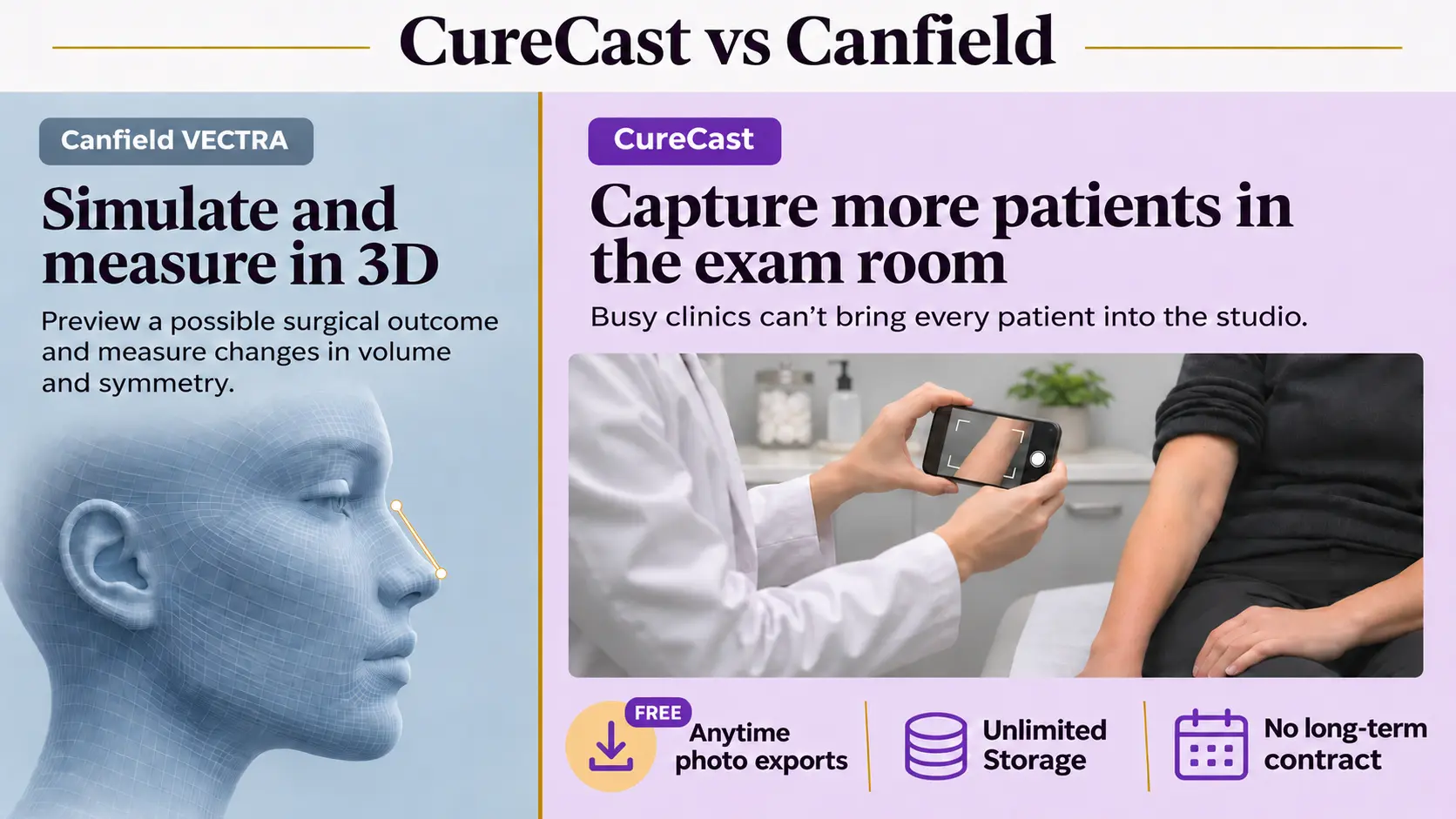
Running both, which is what we would usually suggest
This is the recommendation a comparison page is not supposed to make, so here it is plainly. For a practice that already owns a VECTRA, the question is not whether to replace it. It is what happens to the patients it never sees.
VECTRA keeps
The consultation. Simulation, volumetric measurement, the standardised studio record, and anything destined for a paper or a dispute where measurement precision is the issue.
CureCast takes
Everything else. Post-operative reviews, routine visits, satellite clinics, remote uploads from patients, and the daily business of finding a photograph during a consultation.
The practical test is simple. Count the patients you photographed last month, then count the ones that reached the VECTRA. If the gap is large, the gap is not a software problem you can solve by buying more hardware. It is covered today by a camera roll, and that is the thing worth fixing.
There is no integration between CureCast and Canfield. They are two systems, and running both means two places to look. We think that is a reasonable trade when one of them covers the ninety per cent of visits the other cannot reach, but it is a trade and you should weigh it rather than take our word for it.
Other Canfield alternatives worth knowing
If you are evaluating Canfield you are probably looking at some of these too. A comparison page that pretends CureCast is the only option is not much use to you.
CureCast
Capture on a phone, retrieval in seconds, remote patient upload, published pricing, no storage cap. No 3D.
Crisalix
Cloud-based simulation without a studio. The closest thing to VECTRA's consultation value at a lower commitment, and often used alongside a photo platform.
Arbrea Face
Simulation from a tablet rather than a capture rig. Worth a look if simulation is the reason you were considering VECTRA at all.
RxPhoto
Owned by PatientNow, strong if you run their EMR. Direct alternative to CureCast rather than to Canfield. Compare.
TouchMD
In-room patient education and consultation experience, with its own capture workflow. Compare.
QuantifiCare
3D imaging and quantitative analysis, the other established name in this category alongside Canfield.
How to read any of these pages, including this one. Nearly every comparison between two aesthetic imaging products is written by one of the vendors, roundups included. Check the date, check whether competitive claims are sourced, and ask each vendor the same questions in writing.
Frequently asked questions
What is the difference between VECTRA and Mirror?
VECTRA is Canfield's 3D capture hardware, including the XT and WB360 studio systems and the handheld H2, with simulation and planning software on top. Mirror is Canfield's 2D imaging and patient-records software, whose PhotoFile component manages images in a HIPAA-compliant environment, with Mirror Mobile as an iPad companion.
The distinction matters because CureCast competes with Mirror, not with VECTRA. Comparing a cloud photo app to a 3D capture rig is comparing two different jobs.
Does CureCast do 3D imaging or surgical simulation?
No. No 3D capture, no simulation, no volumetric measurement and no quantitative skin analysis. If showing a patient a predicted three-dimensional outcome is part of how you consult, you need a VECTRA or a simulation product such as Crisalix or Arbrea, and CureCast is not a substitute for either.
How much does a Canfield VECTRA cost?
Canfield does not publish pricing. Resale listings exist but range so widely, from a few thousand for a handheld H2 to five figures for a pre-owned XT workstation, that quoting a figure would mislead you.
What is useful is the structure. Independent guidance on this category recommends asking for three numbers separately: the camera or system price, the price of each simulation module you intend to use, and the annual software and service fee, including what happens to the system if you stop paying it.
Is CureCast a replacement for a VECTRA?
No, and we would not sell it as one. If you own a VECTRA, the useful question is not whether to replace it but what photographs the patients it never sees: post-operative reviews, routine visits, satellite clinics and patients who do not return. In most practices that is currently a phone camera roll.
Can I use CureCast alongside Canfield?
Yes, and for a practice that already owns a VECTRA this is usually the sensible arrangement. VECTRA keeps the consultation, simulation and any measurement work. CureCast covers the day-to-day photography across every visit and location.
Be clear-eyed about the cost of that: there is no integration between the two, so it means two systems and two places to look. We think the trade is worth it when one covers visits the other cannot reach, but it is a trade.
Which is better for before and after photographs?
For a single standardised pair captured in a studio, VECTRA. Fixed cameras, calibrated lighting and a fixed subject position remove operator variation in a way a handheld cannot fully match.
For building before-and-after comparisons across a whole patient list, where images were taken in different rooms over months, CureCast. Guided capture and ghosting narrow the variation, tagging at capture makes any pair retrievable in seconds, and the comparison can be built from any two visits.
Does Canfield work on iPhone or Android?
Mirror Mobile is listed as an iPad app. We found no published iPhone or Android client for either Mirror or VECTRA, which does not mean none exists, only that we could not confirm one. Ask Canfield directly.
CureCast captures on iPhone and iPad, with viewing, searching, comparison and sharing also available on Android and in any desktop browser. TrueAlign guided capture and ghosting are iPhone and iPad only at present.
Do I need a dedicated photography room?
For a VECTRA XT or WB360, yes: these are studio systems with a physical footprint and controlled lighting. The handheld H2 removes the room requirement but remains a separate piece of hardware to carry, charge and look after.
CureCast needs no room and no hardware. That is precisely why it reaches the clinic rooms, the ward and the satellite site.
What happens to my images if I stop paying?
Ask every vendor this, including Canfield and including us, and get the answer in writing. With a capital system there is a further question worth asking: what happens to the software and the archive if you stop paying the annual fee while still owning the hardware?
CureCast has no long-term contract. Export is free, including patient-level downloads that retrieve one patient's complete history together, and there is no charge to leave.
Is there a storage limit?
Not in CureCast. No 500 GB, 1 TB or 10 TB tier to outgrow, and no surcharge for the space your archive occupies. A practice photographing properly will pass a terabyte, because clinical photography is the one clinical record that grows without limit.
We found no published storage terms for Mirror or VECTRA. Ask what the archive costs at scale, and whether it is local, hosted or both.
Is CureCast HIPAA compliant?
No software is HIPAA compliant on its own, and any vendor claiming otherwise is describing something HIPAA does not recognise. Compliance attaches to the covered entity, which is your practice. CureCast is built for HIPAA-compliant workflows: a signed Business Associate Agreement, AES-256 encryption at rest, TLS in transit, per-user access controls and a full audit trail of every view, download and share. Read the detail.
How long has CureCast been running?
Since 2016. Our longest continuously active clinic joined that year and is still on the platform, which tells you more than a founding date does.
Surgeons who use CureCast daily
Independent reviews from practices in Dubai, London and Asia. Video, not paraphrase.


Want to hear from more practices using CureCast? Read more customer reviews →
See where the gap is in your own practice
Fifteen minutes. Bring last month's patient count and we will work out together how many of them actually got photographed. If the answer is most of them, you do not need us.
Book a 15-minute demo Or email [email protected] · 14-day free trial, no credit cardSources and method. Public sources reviewed 10 November 2026. Information about Canfield is drawn from Canfield Scientific's published product pages for Mirror and the VECTRA line, the Mirror Mobile listing on the Apple App Store, peer-reviewed validation literature on VECTRA systems, and independent category guidance on 3D simulation tools. Information about CureCast describes our own product. Where sources conflict, or where we could not confirm something, we say so rather than choosing the version that favours us.
We have deliberately not quoted a VECTRA price. Third-party resale listings vary from a few thousand to five figures depending on model, condition and whether software and installation are bundled, and publishing a single number from that range would mislead you more than saying nothing.
"Not published" means the detail was not found in the sources reviewed. It does not mean a feature is unavailable. Pricing and features change; verify both directly with each vendor before deciding.
To request a correction, email [email protected] with a supporting source and we will amend the page and note the change.
Written by Vishal Parikh, Founder, CureCast Technologies. Last reviewed 10 November 2026.