In short
A patient photo consent form is written permission to use a patient's photo for a named purpose and a stated time. A treatment consent form does not cover marketing. They are two permissions, not one. In CureCast, you start with our ready-made patient photo consent form template or make your own. Your patient signs it on the device. Then you move the best photos to the right album. You search only results you have permission to show.
The question nobody can answer in the room
It is Tuesday afternoon. A new patient sits across from you. She wants to see a nose like the one she has in mind.
You open your rhinoplasty gallery. Four hundred photos. Then you start wondering which of those patients said yes to being shown?
You do not know. Your front desk does not know. So you guess, or you show less. Neither helps her book.
Now picture the other version. Every photo with consent has already moved to your consultation album. You open it. You search it freely. You are not worried. She sees a result that looks like her. She books.
That is what a patient photo consent form should do. It should make the next consultation easier.
Treatment consent is not photo consent
Most clinics use one form to do three jobs.
In the United States, a patient photo counts as protected health information under HIPAA. Using it in marketing needs a separate written permission, called an authorization (45 CFR 164.508). It must say which photos, who may use them, where they will appear, how long, and how the patient can take it back.
A single line inside a surgery consent form rarely covers all of this. Photo consent must also be a free choice. If a patient thinks her surgery depends on saying yes, her yes does not count.
How your patient photo consent form works in CureCast
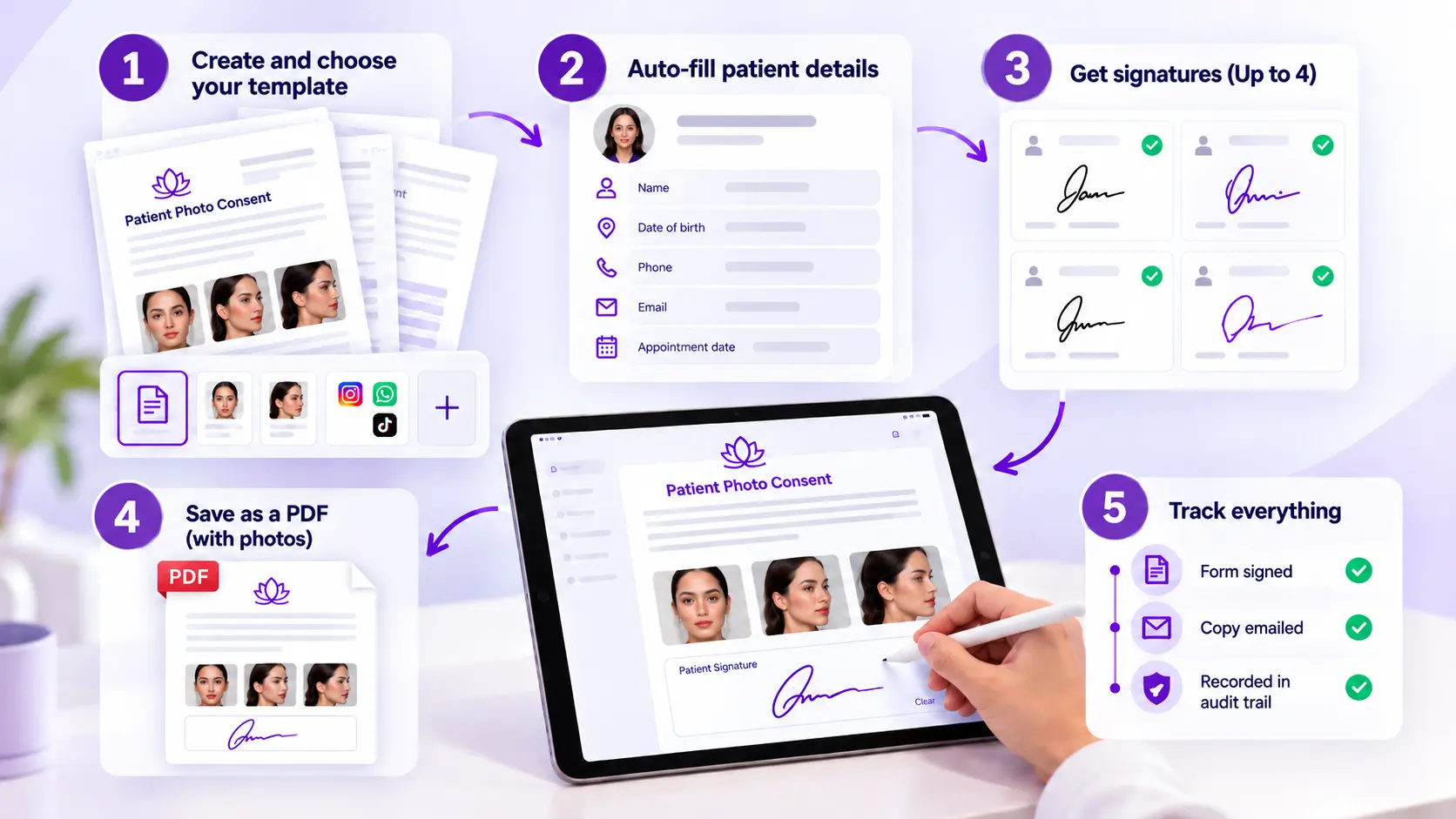
Start with a ready-made template or create your own. CureCast makes it easier to prepare, customise, and use consent forms at every visit.
Who signs, by situation
Built for real clinics
Less typing. No chasing. No guessing.
Think about the last consent form your team filled in by hand. The name typed again. A phone number with one digit wrong. A witness who walked away before signing. Three days later, someone asks: who signed this one?
In CureCast, you click a variable and the patient's details fill in from registration. You design the form your way in a full editor. And you see who has signed and who has not, with the date and time, on one screen.
Before and after photo consent for social media
A before and after takes about 10 seconds to create in CureCast. It can become the Instagram post that brings in your next patient.
But only if the patient said yes to social media.
So make your consent to use patient photos on social media specific:
Name the places. Your website, Instagram, a conference talk. “Social media” is too loose. It covers platforms you have not joined yet.
Let the patient choose. List every use you might want, like your website or Instagram. Let her cross out any use she does not agree to.
Say when the consent ends. “Until the patient withdraws” is usually the safer choice. With a fixed date, every post still online on that date is left without consent.
Plan for changed minds. If a patient withdraws, take the post down and keep the record. Tell her before she signs that copies already saved by others are out of your hands.
Who signs a photo consent form?
The patient signs. The doctor or surgeon may also sign as the treating clinician, where required by the form or clinic’s process. If the patient cannot sign for themselves, a representative signs, and the form says what gives them that right.
For photo consent for minors, a parent or legal guardian signs. Many practices also note the child’s own agreement when the child is old enough. Using a childhood photo years later is a question to ask your adviser, because the person in the photo is now an adult who did not choose it.
Does blurring a face remove the need for consent?
No. A tattoo, a scar, a birthmark, body shape or jewelry can all point to one person. HIPAA also lists full face photos and any comparable image as identifiers. A before and after pair is riskier still, because two photos together show more clues than one.
A blur drawn over a photo can be removed by whoever views the file.
Photo consent rules in three places
Rules differ everywhere. Here is the short version for three of our markets.
Built for real clinical photo workflows
The numbers that matter in a consultation, a follow-up and a before and after.
Consent signers
Up to four signatures on one consent form. Stored with the patient's record.
Find any photo
Search by patient, procedure, body area or date. Show the match while the patient is still in the chair.
Visits in one view
Compare two visits side by side, or four at once to show the full journey. Weeks or years apart.
Reference photos
Pick up to 15 earlier photos as a guide in TrueAlign Match. Every new photo lines up with the last.

See How CureCast Fits Your Practice
Discuss how CureCast fits into your clinical photo workflow, from capturing and organizing patient photos to securely managing them across your practice.
Prefer email? [email protected]
Show results. Know every photo is safe to show.
Build your form once. Use it on every patient. Keep it with the photos it covers.
Standardized clinical photography
- ✓ Match earlier photo views
- ✓ Overlay and outline guidance
- ✓ Consistent before-and-after photos
- ✓ No studio or special equipment required