Quick Summary
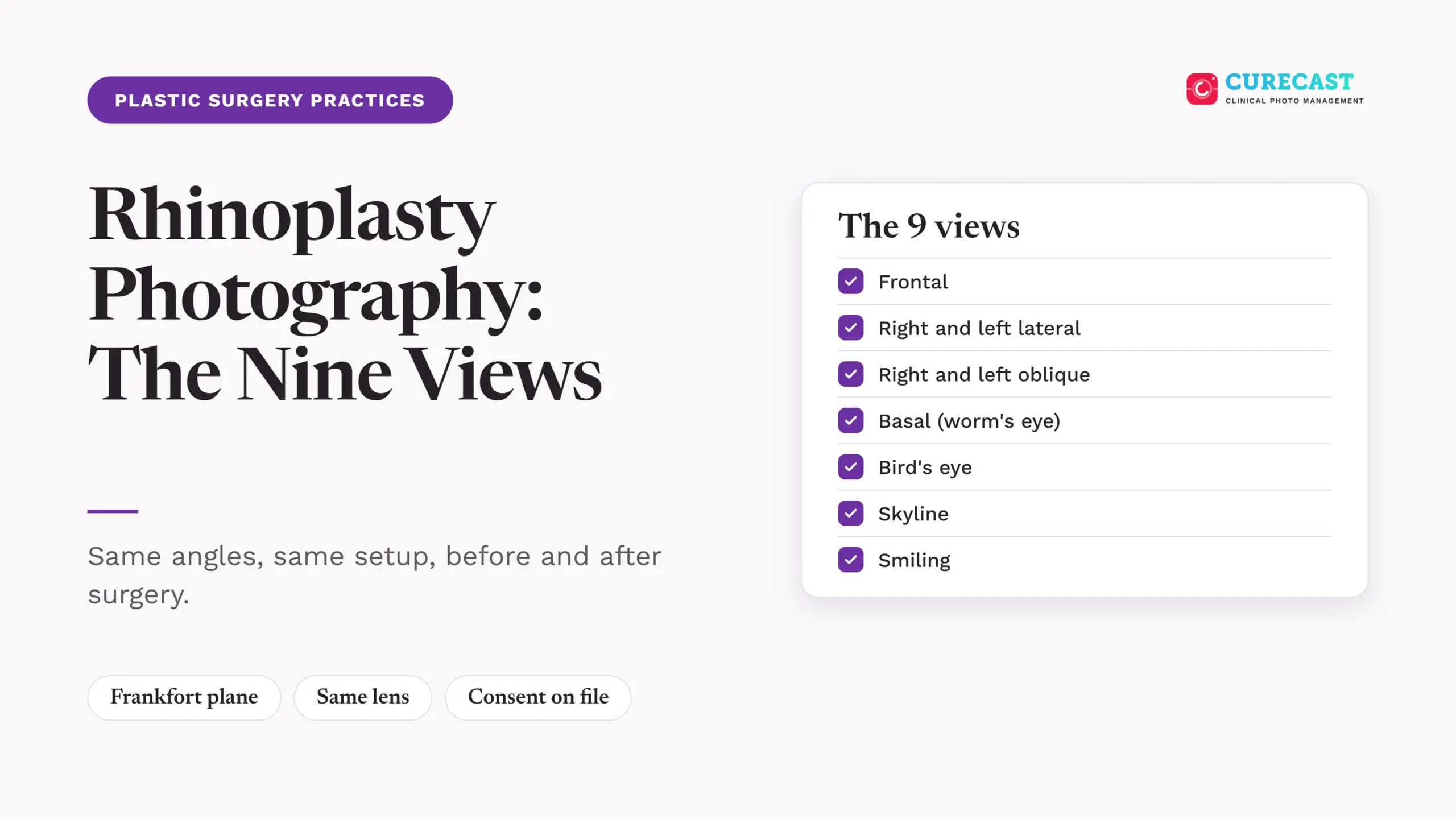
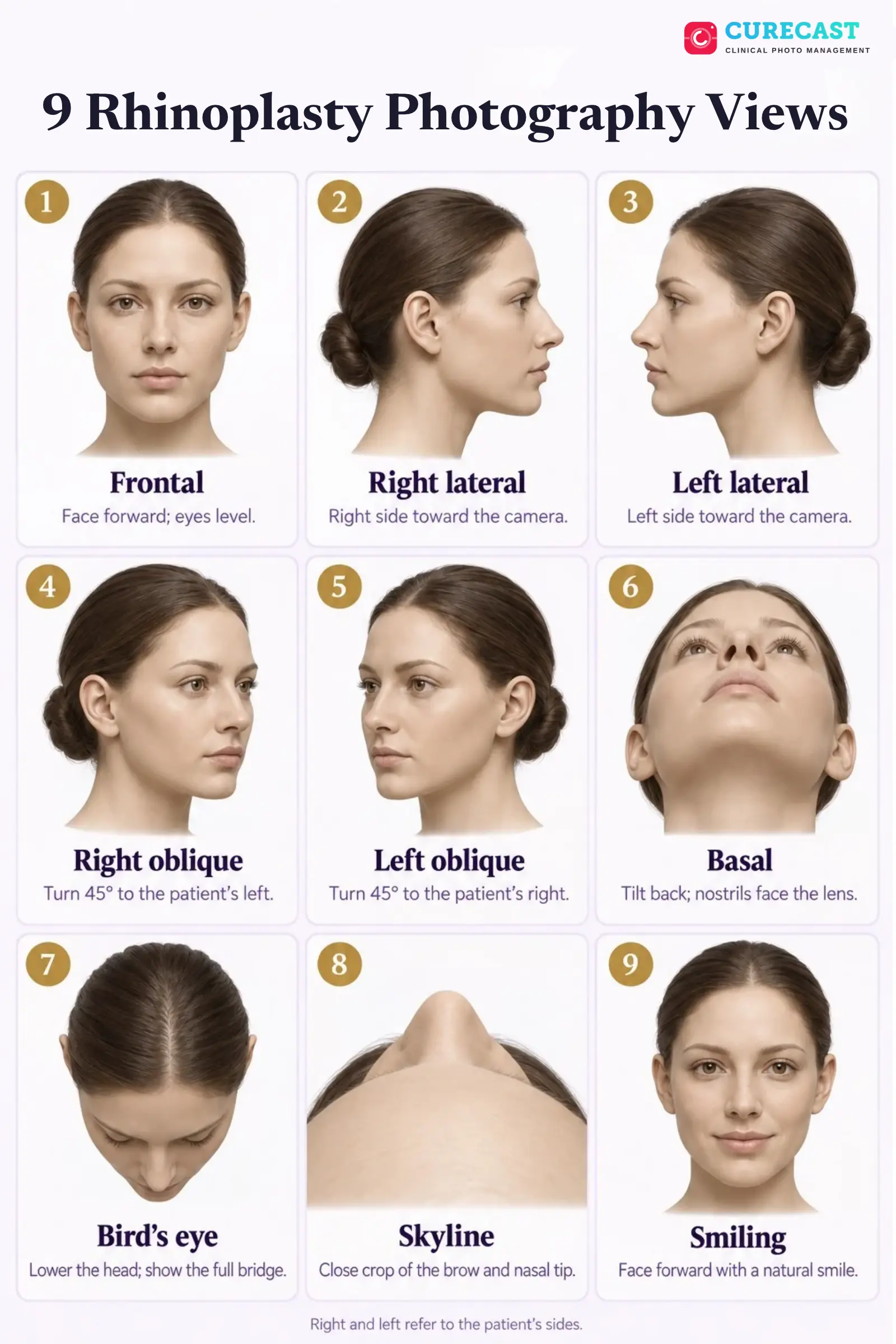
Standardized rhinoplasty photography requires a strict protocol of 9 specific views to ensure accurate before-and-after comparisons. Take the frontal, both profiles, both obliques, the basal view, the bird’s eye view, the skyline view and one smiling view. Take each photo using the same camera angle, distance, and patient position before and after surgery to ensure accurate comparisons.
To get there, do these 3 things:
- Line up the head the same way every time, using the Frankfort plane.
- Keep the lens, distance, background and lighting the same at every visit.
- Store the set in the patient record, with consent on file.
This guide lists each view, how to set it up and the mistakes that make before-and-after photos hard to compare.
Key principle: A rhinoplasty photo is a measurement, not a portrait. If the head tilts or the camera moves closer, the nose looks different even when nothing changed.
Why Are 9 Views Recommended for Rhinoplasty Photography?
No single standard names exactly 9 views, so here’s how we built the list. The UK’s Institute of Medical Illustrators (IMI) rhinoplasty guideline sets out 8 view positions. A US rhinoplasty fundamentals guide by Dr. John Mayo, a general surgery resident at the time of publication, and Dr. Prabhat K. Bhama, a surgeon and medical educator, adds a smiling view. We have combined these recommendations to create a practical 9-view checklist for clinics.
Some guidelines recommend fewer views. For example, the American Society of Plastic Surgeons (ASPS) lists frontal (front), lateral (side), oblique (angled) and basal (from below) views in its nasal surgery practice parameter. A 2024 StatPearls review on rhinoplasty lists frontal, both profiles, both three-quarter views, basal and dorsal views. If your surgeon uses a smaller set, keep it, but use it every time.
What are the 9 standard rhinoplasty views?
The IMI guideline shoots views 1 to 5 as face views and views 6 to 8 as closer views. The smiling view has no fixed angle in the sources we found. Pick frontal or profile for it and record that choice in your photo protocol.
How do you line up the head the same way every time?
Use the Frankfort plane. It’s an imaginary line from the lowest point of the eye socket to the top of the ear opening. For the frontal and profile views, keep that line level with the floor.
The IMI guideline adds these setup rules:
- Seat the patient upright, head straight, both feet flat on the floor.
- Mark the chair position on the floor, so it’s in the same spot next time.
- Stand level with the patient. Keep the camera straight, not tilted to make up for a tilted head.
- Line up the middle vertical grid line with the center of the face.
Important: Fix the head, not the camera. If the patient’s chin drifts up, ask them to lower it. Tilting the camera to match hides the problem.
Which camera settings should you use?
The IMI guideline is written for a dedicated camera. It recommends a 100mm or 105mm macro lens on a full-frame camera, or a 60mm macro lens on a crop-sensor camera. It uses about 3.6 feet (1.1 m) for face views and about 2.2 feet (0.66 m) for the closer views on full frame. It also asks for an aperture of f/16 or smaller, so the whole face is in focus.
Many US practices shoot on an iPhone instead. Lens rules written for cameras don’t map directly to phones, so focus on what stays the same:
- Use the same lens setting at every visit. Don’t switch between zoom levels.
- Don’t stand close to the face. Mayo and Bhama warn that standing too close makes the nose and lips look bigger.
- Turn off the built-in flash. It flattens the nose and can overexpose the skin.
Our guide How do you take HIPAA-compliant photos on an iPhone? covers the phone settings to change before you photograph a patient.
What background and lighting should you use?
Pick one setup and keep it. The sources differ on color, so consistency matters more than the exact choice.
For profiles and obliques, the IMI guideline moves one light toward the front of the nose. That stops the tip from casting a shadow across the cheek.
How do you prepare the patient?
Do this before the first photo, and the same way at every visit:
- Confirm consent for photography is on file. Our patient photo consent form page shows what to include.
- Tie hair back with plain clips or a band.
- Remove glasses, nose studs, nose rings and earrings where possible.
- Ask for no makeup, or very little.
- Move clothing away from the neckline.
- Respect religious or cultural head coverings and note them in the record.
Note: Under HIPAA, a full-face photo is one of the identifiers listed in the de-identification rule (45 CFR 164.514(b)(2)(i)(Q)). Treat every rhinoplasty set as protected health information. You can use the photos for treatment without a separate authorization (45 CFR 164.506). You need written authorization before you use them in marketing (45 CFR 164.508(a)(3)).
What mistakes make rhinoplasty photos hard to compare?
Working outside the US?
The 9 views and the setup work the same in any country. Consent and privacy rules don’t, so check your own country’s rules before you photograph or publish. Our before-and-after advertising guide compares the US, UK, UAE and Australia.
Your clinic’s rhinoplasty photo checklist
- Write a 1-page protocol that lists all 9 views and the angle for the smiling view.
- Choose one background and one lighting setup.
- Mark the chair and camera positions on the floor.
- Use the same camera or phone and lens setting at every visit.
- Check the Frankfort plane before each frontal and profile shot.
- Prepare the patient the same way: hair back, glasses and jewelry off.
- Confirm photo consent before the first shot, and marketing authorization before any ad.
- Save the set to the patient record, not a phone gallery.
Where CureCast fits
CureCast is a clinical photo app for plastic surgery, dermatology and medical spa teams. Its TrueAlign Match feature shows the patient’s earlier photo on the live iPhone or iPad camera screen, as a faded ghost image or an outline. Staff can use it, with the grid and level guide, to line up the brow, nose, lips and chin with the last visit. It doesn’t measure light, so keep your room setup the same.
CureCast supports HIPAA-compliant workflows and provides a signed BAA, starting from your 14-day trial. Your practice is still responsible for its own consent and photo policies. See how standardized before-and-after photos work in CureCast.
Frequently asked questions
Do I need all 9 views for every rhinoplasty patient?
Not always. Published sets range from 5 to 9 views. What matters is that you take the same set before and after surgery, so every view has a match.
Can I take rhinoplasty photos on an iPhone?
Yes. Use the same lens setting and distance at every visit, and turn off the flash. Take the photos in a clinical photo app, not the Camera app.
Is a basal view the same as a worm’s eye view?
Yes. Both names describe the view from below, with the head tilted back until the nostrils face the lens.
Do I need consent to post rhinoplasty before-and-after photos?
Yes. In the US, HIPAA requires written authorization before you use patient photos in marketing (45 CFR 164.508(a)(3)). Our guide Before-and-after advertising rules in the US, UK, UAE and Australia covers the details.
References
All accessed October 24, 2026. Legislation links are listed for you to click; none is marked verified.
US law (HHS, via eCFR)
- 45 CFR 164.514: de-identification identifiers, including full-face photographs (b)(2)(i)(Q)
- 45 CFR 164.506: using PHI for treatment
- 45 CFR 164.508: authorization for marketing (a)(3)
Photography standards and clinical guides
- Institute of Medical Illustrators, National Guideline: Rhinoplasty and Septorhinoplasty (V2, reviewed March 2019): view positions, Frankfort plane, lens, distance, lighting and patient preparation
- American Society of Plastic Surgeons, Practice Parameter for Nasal Surgery (July 2006): standardized preoperative views
- Mayo J, Bhama PK. Photography for Rhinoplasty. Rhinoplasty Archive (last modified August 27, 2020): smiling view, background, lighting and lens advice
- Hohman MH, Fichman M, Piedra Buena IT. Rhinoplasty. StatPearls (updated September 2, 2024): standard rhinoplasty photographs