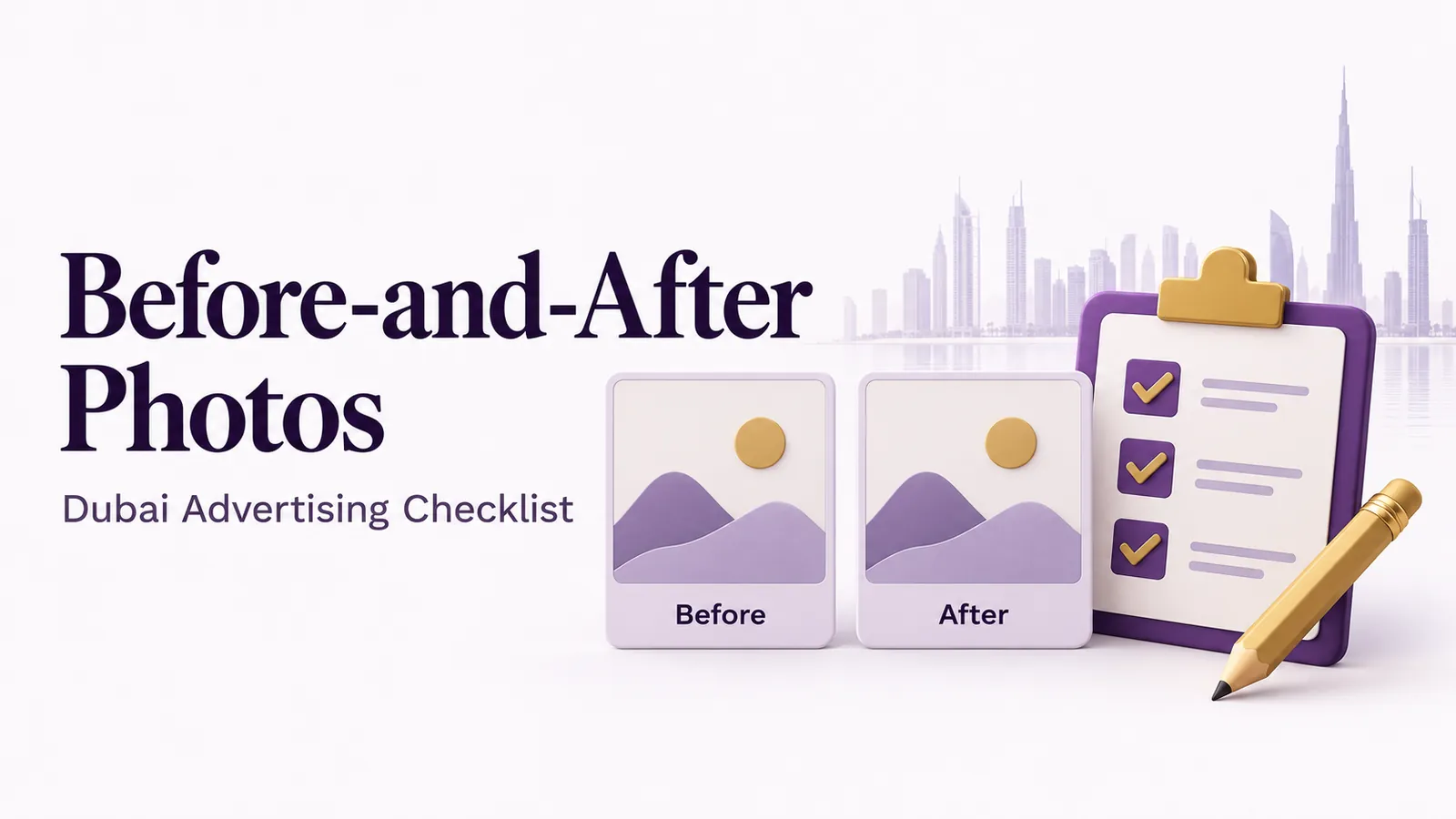
Quick answer: Before a Dubai aesthetic clinic publishes before-and-after photos on social media, check that the patient has given written permission for the planned post. Review the original photos, include the required statement about results and risks, and get the final post approved. DHA’s published standard covers consent, comparable images and medical-director responsibilities. Build these checks into the handover from clinical staff to marketing.
A comparison can be ready for a consultation without being ready for Instagram. The patient may have agreed to clinical photographs but not the proposed advertisement. The designer may have changed the image, or the required wording may be too small to read.
This article focuses on the publishing workflow for DHA-licensed clinics in Dubai. For a country-by-country overview, use our comparison of before-and-after advertising rules. Check other applicable authorities and platform requirements separately.
Start with the original files and documented permission
Keep the clinical original photos linked to the correct patient and visit. When marketing requests a result, prepare a proposed selection rather than moving the whole patient record into a shared design folder.
Check the DHA social-media advertising standard alongside the patient’s permission. Sections 6.10 and 9.1 address documented consent and its scope. Staff should be able to show which photographs, purpose and time period the permission covers.
Do not assume that hiding the patient’s name, cropping the eyes or covering part of a face settles the permission question. Consider the whole image and its accompanying text. The patient may still be identifiable.
Check the pair before it reaches the designer
Section 9.6 of the DHA standard describes before-and-after images of the same individual, taken using the same lens, without Photoshop enhancements or equivalent software. A clinic should therefore keep a repeatable capture process and review the source files before building an advertisement.
- Confirm both photographs belong to the same patient and the intended treatment journey.
- Check the visit dates and whether they support the caption’s description.
- Compare the recorded capture setup, including lens, distance, position and lighting.
- Check whether filters, retouching or enhancement have been applied.
- Keep originals retrievable if the selection or advertising content is questioned.
If the source images are not suitable, do not repair the comparison by making a treatment result look more favorable. Ask the clinical team whether a different, appropriately permitted example is available.
Use an approval checklist for every proposed post
1. Patient permission matches the use
Record who checked the consent, which image set is proposed and which channel will carry it. Confirm that the permitted period still covers the planned publication. Our patient consent form overview explains the product workflow to discuss during setup.
2. Images represent the case accurately
Confirm the photographs and caption describe the same treatment journey. Review framing and presentation so the layout does not create a misleading impression. Using consistent capture helps, but it does not replace review of the final advertisement.
3. Outcome wording and risks are readable
The DHA standard requires a statement explaining that the same result is not guaranteed and can vary between individuals, together with the risks. Section 9.6 specifies the same font size as the rest of the social-media advertisement. Use the source’s required wording and have the complete final layout checked, including how it appears on a phone.
4. The caption avoids unsupported promises
Check the words around the images, not only the image itself. The DHA standard lists unacceptable promotional language and misleading claims. Avoid adding an outcome promise that the underlying record or approved advertisement cannot support.
5. The medical director’s approval is recorded
The standard assigns responsibilities to the medical director. Agree who gathers the image, consent, caption and final artwork for review, and record the approval before publication. A last-minute message saying “looks good” may not preserve all the material that was actually approved.
Be careful with procedure-room video
Section 9.7 of the DHA standard restricts promotional filming or live streaming during surgery, under general anaesthesia and in procedure rooms in DHA-licensed facilities. Do not treat ordinary patient photo permission as a blanket approval for filming in those situations. Review any proposed content against the specific rule.
Keep a simple publication record
For each approved post, retain the selected image identifiers, patient permission reference, final artwork and caption, approving person, date and publication channel. Make it possible to find this record later without searching personal chats.
If an image is changed after approval, decide whether it needs a new review. If the patient changes their permission or the clinic identifies an error, a publication record helps the team locate the affected posts.
How CureCast supports the photo handover
CureCast’s before-and-after photo management tools help teams retrieve patient photographs and prepare comparisons. Keep the clinical originals, consent review and approved marketing selection connected in your clinic’s process. Software does not decide whether a particular advertisement meets every applicable rule.
For UAE hosting and a demonstration of your clinic’s workflow, see clinical photo management software for Dubai clinics. For the broader consent and storage discussion, read the DHA clinical photography guide.
Frequently asked questions
Can we use the same consent for any future social post?
Check the actual scope and permitted period. DHA’s published standard limits consent to the subject for which it was requested and the period granted. Avoid assuming that one form permits every future use.
Can a small disclaimer fix a misleading comparison?
Review the images, claims and presentation together. Adding a disclaimer does not make misleading or digitally enhanced before-and-after photos acceptable. Section 9.6 also specifies the font-size requirement.
Does this article cover every UAE clinic?
No. Its operational checklist is based on a DHA social-media standard. Clinics under other authorities, including Abu Dhabi or Dubai Healthcare City, should confirm the rules that apply to them.
Official reference
DHA Standards for Medical Advertisement Content on Social Media, issue 1.1, August 3, 2022. Relevant sections: 6.10, 7 and 9. Source checked October 31, 2026. Confirm applicable current requirements before publication.