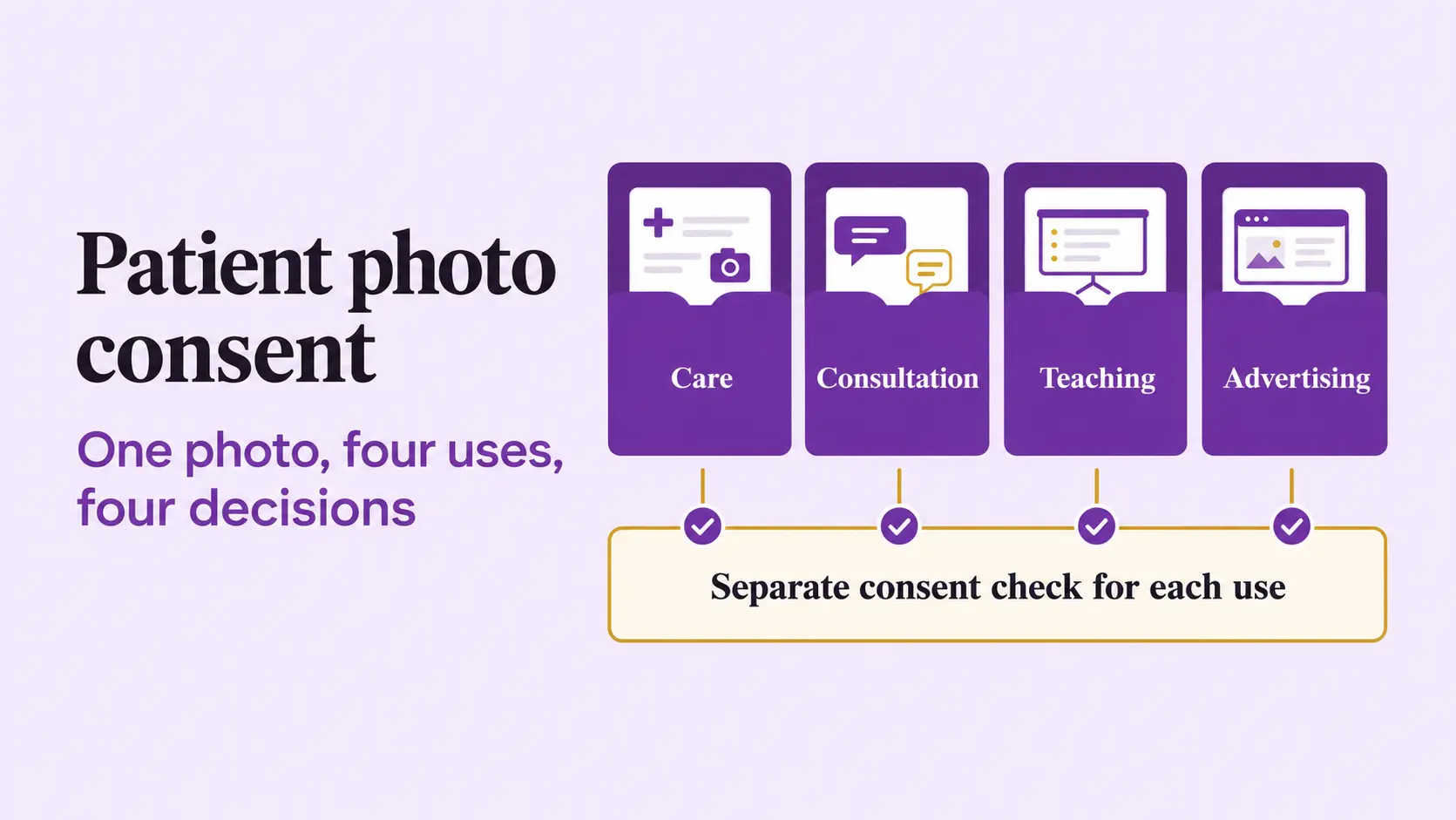
A clinical photo used to review a patient’s own treatment and a photo published to attract new patients have different purposes. UK clinics should treat each use of a clinical photo as a separate patient photo consent decision. Taking the photo for the patient’s own care, showing it in another patient’s consultation, using it for teaching, and using it in public advertising are four different uses. When a patient agrees to one of them, that does not cover the others.
This guide explains a practical patient photo consent workflow for UK clinics. It is general information, not legal advice. Check current professional, privacy and advertising requirements for your clinic and treatment.
Note: The General Medical Council (GMC) describes three uses: care, teaching and training, and public media. It does not list showing a photo to another patient. But this means showing a patient's photo to someone who is not part of their care, so ask the patient to agree to it separately.
Patient photo consent: start with how the photo will be used
A rhinoplasty patient asks, “Has the swelling changed?” The surgeon needs that patient’s earlier photos to answer. Another patient asks, “Have you treated a nose like mine?” The surgeon may want to show before and after photos of someone else. A marketing staff then asks to post a before and after comparison on Instagram.
These are different uses of a photo, and each one needs its own consent check. Finding a suitable photo is only the first step. Next, check that the patient agreed to that exact use. The table below covers all four uses, including teaching, which is the fourth use.
| Situation | Photo workflow | Check before use |
|---|---|---|
| Reviewing the patient’s own progress photos | Retrieve matching views from their visit history. | Clinical purpose, consent discussion and correct patient record. |
| Showing a previous patient’s before and after photos to someone else | Prepare a separate consultation selection. | Whether the patient’s original consent covers this use, or whether another valid authority (such as a legal requirement) applies. |
| Using patient photos for teaching or training | Choose only the photos needed for the audience. | Whether the patient can be identified, whether consent or another valid authority applies, and your local policy. |
| Posting before and after photos on a website, social media or other advertising | Review a proposed publication separately. | Patient permission and advertising rules for the treatment, photos and wording. |
Consent to take clinical photos for a patient’s care
The General Medical Council (GMC) says doctors must get the patient’s consent before taking a clinical photo that forms part of their care. The doctor should explain why the photo helps their care, what it involves and that it will be stored securely, and should write down the key points of that talk in the patient’s record. A clinical photo taken for care becomes part of the medical record, so it must be kept secure, and decisions to share it must be as careful as for written notes.
For an ordinary clinic photo session, agree which photos and angles you need before opening the camera. Explain whether you are recording how things look before treatment, following a skin concern or comparing recovery visits. If a patient says no, or asks you to stop, do not carry on taking photos.
If you’re taking photos to compare recovery across visits, see our guide to consistent follow-up photography for UK plastic surgery and dermatology practices.
Source: GMC guidance on recordings made as part of care.
Showing a previous patient’s photos in a consultation needs a consent check
Showing a previous patient’s photo to someone else on a tablet, even in a private consultation, is still sharing it. GMC principles say a photo that could identify the patient can only be used or shared with their consent or another valid authority. They also say you must not use it for a purpose outside the original consent without getting further consent.
As a practical clinic rule, record the permitted purposes alongside each patient photo. Staff preparing a consultation album should be able to tell “clinical record only” photos apart from photos approved for consultation use. Do not assume permission from an album name or because a photo was shared before.
Cropping a patient’s face does not always make a photo anonymous. Scars, tattoos, distinctive features and the background can still identify the patient. Refer to the GMC recording principles when setting your policy.
Using patient photos for teaching and training
Teaching is a different use again. GMC guidance says a patient photo can be used for teaching or training without the patient’s consent only if it has been made anonymous or coded (the patient’s name is replaced with a code), so the patient cannot be identified. If the patient could be identified, you need their consent or another valid authority. Small details such as scars or tattoos can still identify someone.
Source: GMC guidance on recordings made as part of care.
Posting before and after photos on Instagram or your website adds another decision
GMC guidance says you must get the patient’s consent before taking a patient photo that will be shown in public, for example on a website, in a social media post or in a printed leaflet. The consent should usually be in writing. Sometimes a photo is taken for care and you later want to publish it. If the patient can be recognised, or might be recognised, you must get their consent first. A signature on a treatment consent form does not cover this.
Advertising rules are a separate check. The Advertising Standards Authority and the Committee of Advertising Practice (together, ASA/CAP) say that prescription-only medicines, such as Botox, cannot be advertised to the public. A before and after photo for a prescription-only treatment is very likely to be seen as an advert for it, even with no words next to the photo.
Other treatments still have advertising rules. ASA/CAP treat a before and after photo in the same way as a patient testimonial, which means they see it as a claim about the result of the treatment. Keep signed and dated proof that the photos are genuine and have not been edited. If an advert is misleading, adding small print does not fix it. Patient permission does not remove these rules.
If your clinic publishes before and after photos in more than one market, see our guide to before and after photo advertising rules for a country-by-country overview.
Sources: GMC public-media guidance and ASA/CAP before and after photos advice.
Patient photo consent handover between clinical staff and marketing
- Capture into the correct patient record. Check identity, visit and view before taking the photo.
- Record the purpose of the photo. Keep the consent discussion and relevant signed forms available.
- Use photos taken the same way. Check body site, angle, lighting and visit dates before creating a before and after comparison.
- Prepare a proposed selection of photos. Keep public-use candidates separate from the full clinical record.
- Check permission and the advertisement. Name the person responsible for each review; they may be different people.
- Record the decision. Keep the selected files, proposed wording, publication channel and approval record under the clinic’s process.
- Handle changes. Give staff a clear route for consent questions, withdrawal requests and correcting published photos. Review clinical-record retention separately from marketing use.
Where CureCast fits in patient photo consent
CureCast helps teams retrieve patient and procedure photos, select photos from different visits and keep signed consent forms with the patient record. Your clinic sets staff permissions for patient photos and decides which photos are appropriate for each use. CureCast does not approve an advertisement or make that decision for you.
For consent forms, see patient consent forms. For data protection questions, read the UK/EU patient-photography privacy guide.
See how CureCast supports clinical photo management for UK clinics, from capturing photos to reviewing them at follow-up.
Frequently asked questions about patient photo consent
Can we show one patient another patient’s before and after photos?
Only if that patient agreed to this use, or another valid authority covers it. Consent to take the photo for their care does not cover showing it to another patient. A private consultation is still sharing the photo.
Can patient consent make a Botox before and after photo advert acceptable?
No. Patient permission does not change the rule that prescription-only medicines such as Botox cannot be advertised to the public. ASA/CAP say before and after photos of such a product are very likely to be seen as an advert.
Do we need a new copy of every patient photo for marketing?
Not necessarily. What matters is that each photo chosen for marketing has a permission check and an approval record. Keep marketing selections separate from the full clinical record, and avoid unmanaged copies on personal devices.
Disclaimer: This post is general information, not legal advice, a certification or a guarantee of compliance with any law. Rules differ by country, state and type of practice. Check the official guidance that applies to you, and consult a qualified legal adviser if you are unsure.