Quick summary
Yes, you can use patient before-and-after photos in marketing in all 4 markets, with conditions. You need the patient’s written permission, and the photos must be real, unedited and a fair picture of typical results. Each country then adds its own rules on disclaimers, consent and what you can’t show.
This guide puts the rules of 4 countries side by side. It helps to check your ad or social media post before you publish it. It covers advertising rules only. Storage and security belong in our guide “Is a phone gallery HIPAA compliant?”.
Legal review flag: this post summarizes official rules as of October 2026. Rules change, and each market has more detail than fits here.
Can you use patient before-and-after photos in marketing?
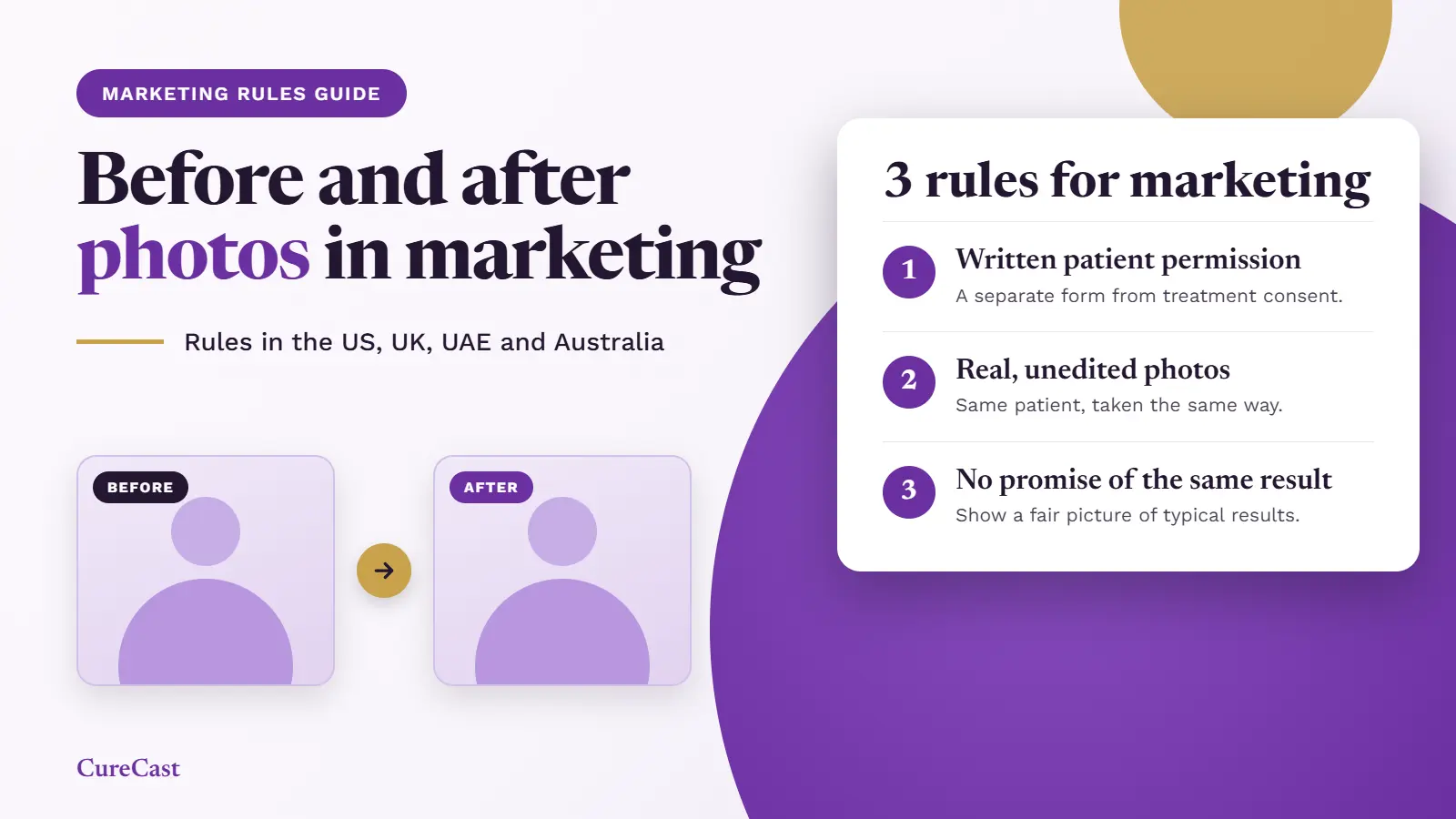
Yes, if these 3 things are true:
- The patient gave written permission to use their photos for marketing. This permission is separate from their consent for treatment.
- The photos are real. They show the same patient, taken in the same way, and are not edited.
- The ad does not suggest that every patient will get the same result. When people see an “after” photo, they expect to get that result too.
The table below shows where the 4 countries are different.
| What to check | United States | United Kingdom | UAE (Dubai) | Australia |
|---|---|---|---|---|
| Main rules | HIPAA, and the rules on endorsements from the FTC (the US consumer protection agency) | The CAP Code, the UK rulebook for ads, enforced by the ASA (the UK advertising regulator) | The standards for medical ads on social media from the DHA (Dubai Health Authority) | The advertising guidelines of the Medical Board of Australia and Ahpra (the health practitioner regulator) |
| Patient permission | Signed HIPAA form for marketing use | Signed, dated proof the photos are real. UK GDPR also applies. | Written consent, only for the stated purpose and time | The patient’s fully informed consent, on record, separate from the treatment consent. For surgery, only photos of your own patients. |
| Image rules | Must not mislead people about typical results | Must not overstate the result. Keep a record of any edits. | Same person, same lens, no editing software | Real images, not edited or enhanced. The “after” image must not be bigger or more prominent than the “before” image. |
| Wording you must add | “The generally expected performance”, shown clearly and in plain sight, if the photo shows a better result than most patients get | The CAP Code gives no set wording. A disclaimer cannot fix a misleading photo | “There is no guarantee that the result will be the same”, and the risks, in the same font size as the ad | “The outcomes shown are only relevant for this patient”, as a prominent warning (for cosmetic surgery and higher risk non-surgical treatments) |
| Watch out for | No marketing use without the signed form | No public ads for prescription-only medicines such as Botox, including before-and-after photos | No filming or live streaming for promotion while a patient is in surgery or in a procedure room | No testimonials. For cosmetic surgery, no single photos that suggest a surgical result. |
What are the US rules?
HIPAA. If a patient can be identified from a photo, you generally need their signed permission before using it to advertise your clinic. HIPAA calls this an authorization. It must be separate from the patient’s treatment consent and include an expiry date or event. Patients can withdraw their permission. You cannot refuse treatment because a patient does not agree to marketing.
FTC rules on endorsements. The FTC (Federal Trade Commission) protects consumers from misleading advertising. It treats a before-and-after photo as a claim about treatment results. People may assume they can expect similar results. If the photo shows a better result than most patients get, clearly explain what patients can generally expect. Simply saying “results not typical” is not enough. The FTC found that people may still believe the photo shows a normal result.
State rules. Some US states have extra rules for before-and-after photos. For example, California Business and Professions Code section 651 requires before-and-after photos to be comparable. Changes in lighting, poses or camera angles must not make results look better than they are. Ads must also explain that not every patient will get the same result. Check with your state medical board to find out which rules apply to your clinic.
What are the UK rules?
The Advertising Standards Authority (ASA) is the UK advertising regulator. It makes sure clinics follow the CAP Code, the UK’s advertising rules. The ASA says clinics should keep signed and dated proof that before-and-after photos are real and have not been changed. But real photos alone are not enough. You also need evidence that the treatment can usually achieve the results shown.
Three important rules for UK clinics:
- Botox and other prescription-only medicines. You cannot advertise these medicines to the public. Even a before-and-after photo showing Botox results can break the rules, whether or not you add any text.
- Edited photos. Do not change photos to make treatment results look better. Keep both the original and edited versions so you can show exactly what was changed.
- Under-18s. Ads for cosmetic procedures must not target people under 18. Do not place these ads where 25% or more of the audience is under 18.
A disclaimer cannot fix a misleading ad. If a photo gives people a false impression of the results, adding a warning or explanation does not make the ad acceptable.
What are the UAE rules?
In Dubai, the Dubai Health Authority (DHA) sets rules for medical ads on social media. They cover every clinic and healthcare professional that the DHA licenses. The DHA standard says:
- You need written consent from every patient shown, and you must keep a record of it.
- The consent covers only the purpose and the time period that the patient agreed to.
- For anyone under 18, get consent from a parent.
- Before-and-after photos must show the same person, taken with the same lens, with no editing software.
- Add this line, and list the risks, in the same font size as the rest of the ad: “there is no guarantee that the result will be the same, as it might vary from one individual to another.”
- Do not film or livestream a patient for promotion during surgery, under general anaesthesia, or in a procedure room.
- The medical director of the clinic must approve any post that names the clinic or shows where it is.
The standard also bans words such as “safest”, “assured success”, “miraculous” and “immediate results”. The DHA has published updates to its social media ad rules, so check the latest version on the DHA website before you post.
In Abu Dhabi, the Department of Health (DoH) is the health regulator. We could not find a published DoH rule on before-and-after photos. Check with the DoH before you post.
Federal Law No. 2 of 2019 is the UAE law on health information. It covers patient photos too, and it says a patient’s information may be used for non-health purposes only with the patient’s written approval.
What are the Australian rules?
Australia’s rules depend on the type of procedure.
Cosmetic surgery (from 1 July 2023). The Medical Board of Australia says before-and-after images must show realistic results, and must be of real patients of the doctor who is advertising. The first image people see must be the “before” image or a combined image of both. Images must not be edited or enhanced, and must not show anyone under 18. Every image that shows a surgery result must carry a prominent warning that the results shown are only relevant for this patient. Single photos that suggest a surgical result are not allowed. Testimonials, which are positive statements about the medical side of your service, are not allowed. This includes sharing or liking a patient’s post that praises you. See the Medical Board FAQ.
Higher risk non-surgical treatments (from 2 September 2025). These guidelines cover treatments such as injections and fillers. Ahpra says images must not be edited or enhanced, and the first image people see must be the “before” image or a combined image of both. Every image that shows a treatment result must carry a prominent warning that the results shown are only relevant for this patient. Do not use images of people under 18, and do not aim ads at them.
Ahpra and the Medical Board cannot check or approve your ads before you post. They do run audits of cosmetic surgery ads.
A checklist for posting before-and-after photos
- Get a separate, signed marketing consent from every patient shown. State the purpose and an end date. (All 4)
- Write down which photos each patient agreed to share. Stop using them when the consent ends or the patient takes it back. (US, UAE, Australia)
- Use only real, unedited photos of your own patients, taken in the same way. (UAE, Australia)
- Show the “before” and “after” photos at the same size. (Australia)
- Add the right wording for each country, such as the DHA line in Dubai. (US, UAE, Australia)
- In the UK, do not post before-and-after photos of Botox or other prescription-only treatments. (UK)
- Keep the original files, and a record of any edits. (UK)
- Name one person who approves every post before it goes live. (UAE)
Where CureCast fits
Consistent photos make these rules easier to follow. CureCast’s before-and-after photo tools let you build side-by-side comparisons from photos saved in the patient’s file. The standardized photography tools help you take each follow-up photo in the same position as the first one.
CureCast supports HIPAA-compliant workflows. Your clinic still decides what to publish, and must check each ad against the rules of its own country.
Frequently asked questions
Is a treatment consent form enough to use photos in marketing?
No. In the US, HIPAA asks for a separate written permission for marketing. In Dubai, consent covers only the purpose and the time period it was given for. In every country, use a separate marketing consent.
Can I crop out the face and skip consent?
Not safely. A photo of a body can still show who the patient is, for example through tattoos, scars or the room. Get written consent for any patient photo you use in marketing.
Can I edit the lighting or the background?
Be careful. Dubai does not allow editing software on before-and-after photos. In the UK, you must be able to show whether a photo was retouched. In Australia, photos must not be edited or enhanced. The simplest way is to use the original photos, and keep the original files.
Does a “results may vary” line make any photo acceptable?
No. In the UK, the ASA says an ad that misleads stays misleading, even when a disclaimer is added. In the US, the FTC found that “results not typical” wording does not change what people take from the photo. Dubai and Australia do ask for a warning line in some cases, but the line does not make a misleading photo acceptable.
References
United States
- 16 CFR 255.2: FTC rules on endorsements by consumers
- 45 CFR 164.508: HIPAA authorization, including marketing
- California Business and Professions Code 651: state rules on health care advertising
United Kingdom
UAE
- DHA: Standards for Medical Advertisement Content on Social Media
- UAE Federal Law No. 2 of 2019, on the use of information and communication technology in health fields