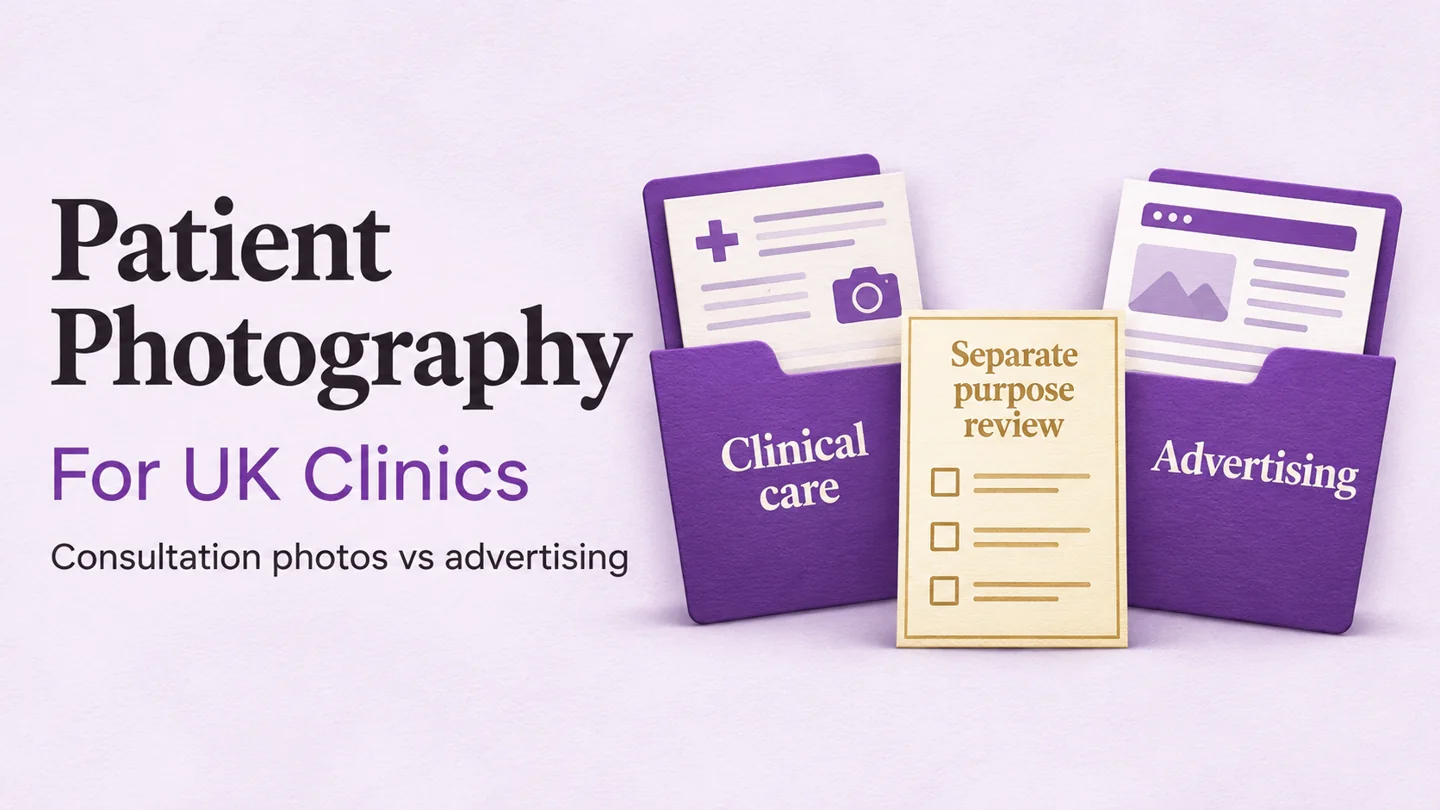
A photograph used to review a patient’s own treatment and a photograph published to attract new patients have different purposes. UK clinics should keep clinical capture, use in another patient’s consultation, teaching and public advertising as separate decisions. Consent to one use does not automatically cover the others.
This guide explains a practical workflow. It is general information, not legal advice. Check current professional, privacy and advertising requirements for your clinic and treatment.
Start with the intended use
A rhinoplasty patient asks, “Has the swelling changed?” The surgeon needs that patient’s earlier photographs. Another patient asks, “Have you treated a nose like mine?” The surgeon may want to show photographs of someone else. A marketing colleague then asks to post a comparison on Instagram.
These are three different decisions. Finding a suitable photograph is the first step; checking whether it can be used for that purpose is the next.
| Situation | Photo workflow | Check before use |
|---|---|---|
| Reviewing the patient’s own progress | Retrieve matching views from their visit history. | Clinical purpose, consent discussion and correct patient record. |
| Showing a previous patient’s result to someone else | Prepare a separate consultation selection. | Whether the original permission or another valid authority covers this disclosure. |
| Teaching or training | Choose only the images needed for the audience. | Identifiability, consent or other authority and local policy. |
| Website, social media or other advertising | Review a proposed publication separately. | Patient permission and advertising rules for the treatment, images and wording. |
Taking photographs for the patient’s care
For clinical recordings that require specific consent, GMC guidance says doctors should explain why the recording assists care, what it involves and that it will be stored securely. Key elements of the discussion should be documented. Recordings made as part of care belong to the medical record and need appropriate security and disclosure decisions.
For an ordinary clinic photo session, agree the views you need before opening the camera. Explain whether you are documenting a baseline, following a skin concern or comparing recovery visits. If a patient declines, follow your clinic’s clinical and consent procedures.
Source: GMC guidance on recordings made as part of care.
A consultation album still needs a permission check
A previous patient’s photograph does not become suitable for disclosure simply because you show it privately on a tablet. GMC principles require appropriate consent or other valid authority for identifiable uses and prohibit use outside the original consent’s scope except in specified circumstances.
As a practical clinic rule, record the permitted purposes alongside the images. Staff preparing an album should be able to distinguish “clinical record only” from material approved for the proposed consultation use. Do not infer permission from an album name or from the fact that a photograph was shared before.
Cropping a face does not necessarily remove identifying details. Consider scars, tattoos, distinctive features and the surrounding context. Refer to the GMC recording principles when setting your policy.
Public advertising adds another decision
GMC guidance generally requires consent, usually in writing, for recordings made for widely accessible public media. It also addresses publishing photographs originally made for care. Review that guidance for the particular use rather than treating a treatment-consent signature as blanket permission.
Advertising rules are an additional check. ASA/CAP states that prescription-only medicines, including Botox, cannot be advertised to the public. A before-and-after image of a prescription-only product can itself be an implied advertisement, even without an accompanying claim.
For other treatments, review the proposed advertisement’s overall impression, evidence and image presentation. ASA/CAP treats before-and-after photographs as claims about what a product or treatment can achieve. Keep evidence of authenticity and do not rely on a disclaimer to cure a misleading impression. Patient permission does not override these rules.
Sources: GMC public-media guidance and ASA/CAP before-and-after advice.
A practical handover between clinical staff and marketing
- Capture into the correct patient record. Check identity, visit and view before taking the photograph.
- Record its purpose. Keep the consent discussion and relevant signed forms available.
- Compare like with like. Check body site, angle, lighting and visit dates before creating a comparison.
- Prepare a proposed selection. Keep public-use candidates separate from the full clinical record.
- Check permission and the advertisement. Name the person responsible for each review; they may be different people.
- Record the decision. Keep the selected files, proposed wording, publication channel and approval record under the clinic’s process.
- Handle changes. Give staff a clear route for permission queries, withdrawal requests and correcting published material. Review clinical-record retention separately from marketing use.
Where CureCast fits
CureCast helps teams retrieve patient and procedure photographs, select images from different visits and keep signed consent forms with the patient record. Your clinic configures staff permissions and decides which photographs are appropriate for each use. The software does not approve an advertisement or make that decision for you.
Explore CureCast for UK clinics, before-and-after comparisons and patient consent forms. For data protection and processor questions, read the UK/EU patient-photography privacy guide.
Frequently asked questions
Can we show one patient another patient’s results?
Check whether the proposed disclosure is covered by appropriate consent or other valid authority. A private consultation is still a disclosure; do not assume clinical-record consent covers it.
Can a patient’s permission make a Botox before-and-after advert acceptable?
Permission alone is insufficient. ASA/CAP’s prescription-only medicine advertising restrictions apply separately.
Do we need a new copy of every photo for marketing?
Set up a controlled selection and approval process that works for your clinic. Avoid unmanaged duplicates on personal devices; being able to retrieve a file does not establish permission to publish it.