Quick summary
Yes, with strict conditions. The images must be genuine and unedited, depicting the practitioner’s own patients, captured under the same conditions both times. The “before” photograph or a combined image must appear first, and the advertisement must include a warning that the outcome applies only to that patient.
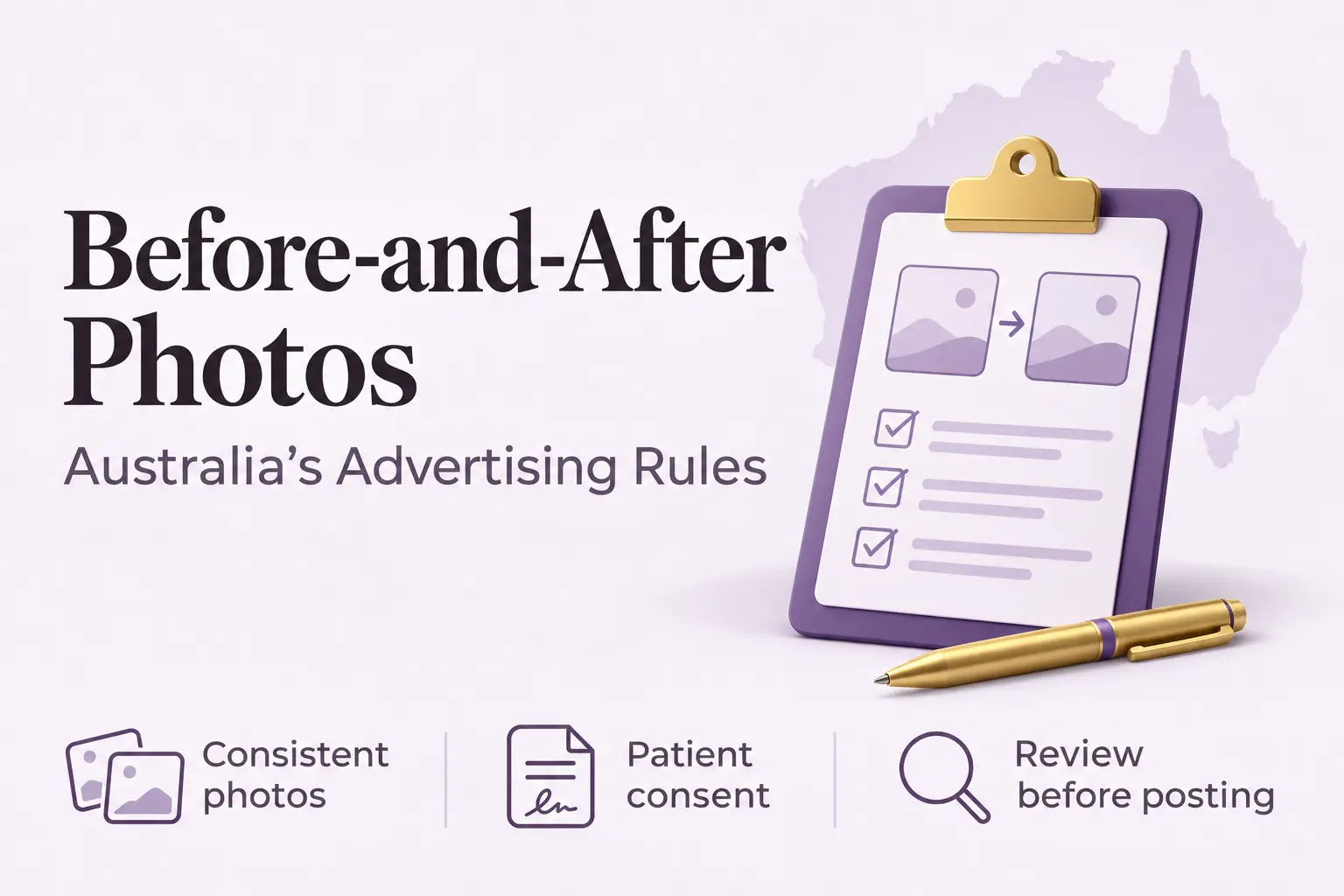
Three steps apply to every before-and-after advertisement:
- Identify which guideline covers the treatment: cosmetic surgery, or higher-risk non-surgical procedures such as injectables.
- Capture both photographs under identical lighting, angle, background, pose, clothing and makeup.
- Obtain separate, fully informed consent for advertising use, and document it.
This guide presents both rule sets side by side and concludes with a pre-publication check.
For the product workflow, see CureCast clinical photo management for Australian clinics, including photo search, follow-up comparisons and secure patient upload.
Before preparing a photograph for publication, review the separate permissions covered in our Australian patient photography consent guide.
Key principle
Ahpra expects before-and-after images to inform patients, not to promote procedures (cosmetic surgery guideline, section 6.8).
Which Ahpra guideline applies?
Two sets of rules now govern before-and-after photographs.
| Procedure | Guideline | Who it applies to | In effect since |
|---|---|---|---|
| Cosmetic surgery (procedures that cut beneath the skin, such as breast augmentation, rhinoplasty, liposuction) | Medical Board of Australia, Guidelines for registered medical practitioners who advertise cosmetic surgery | Medical practitioners, and anyone advertising on their behalf | 1 July 2023 |
| Higher-risk non-surgical procedures (such as anti-wrinkle injections, dermal fillers, thread lifts, injection lipolysis, hair transplants) | Ahpra and National Boards, Guidelines for advertising higher risk non-surgical cosmetic procedures | Registered practitioners in all professions, plus unregistered individuals and businesses that advertise these procedures | 2 September 2025 |
Ahpra’s general advertising rules also apply. Nurse injectors, dentists offering veneers and medical spas all fall under the non-surgical rules.
Our guide Before-and-after advertising rules in the US, UK, UAE and Australia compares jurisdictions. This post covers the Australian rules in detail.
Image requirements
Both rule sets set comparable standards. The surgery rules provide additional specificity.
| Rule | Cosmetic surgery (section 6) | Higher-risk non-surgical (section 5) |
|---|---|---|
| Real patients only | Photographs of actual patients treated by that practitioner (6.4) | Genuine photographs of patients treated by that practitioner (5.4) |
| Matching conditions | Same content, lighting, camera angle, background, framing, exposure, posture, clothing and makeup (6.6) | Same lighting, angle, background, pose, clothing and makeup (5.4) |
| No editing | No filters, retouching, greyscaling or similar modification (6.7) | Not edited or enhanced; no airbrushing or soft filters (5.2, 5.4) |
| Presentation order | The “before” photograph or a combined image must appear first (6.5) | The “before” photograph or a combined image (5.4) |
| Warning | A prominent warning that the result applies only to that patient and may not reflect others (6.3) | A prominent warning that the outcome is relevant only for that patient (5.3) |
| Timing | Consider when “after” photographs are taken, as early swelling can obscure results (6.7) | State how long after the procedure the “after” photograph was taken (5.4) |
| Under 18 | No images of anyone under 18 (6.2) | No images of anyone under 18 (5.5) |
| Models | No images of models or celebrities (6.1) | No models or celebrities who have not had the procedure (5.2) |
Prohibited content in cosmetic surgery advertisements
Section 6.9 of the cosmetic surgery guideline prohibits the following in images, captions or descriptions:
- Sexualised poses, lingerie, simulated undressing or oiled bodies
- Gratuitous nudity, including censored breasts unrelated to breast surgery
- Emojis covering body parts or indicating emotion
- Lifestyle settings such as beaches, pools, beds or hotel rooms
- Patients' emotional reactions, real or claimed
- Captions that idealise surgery or minimise risk (e.g. "more natural", "hot", "younger")
- Patient names or links to their social media accounts
Consent requirements
Advertising consent is separate from surgical consent (section 6.10(a)). The cosmetic surgery guideline requires practitioners to:
- Explain where the images will be used and for how long.
- Warn that others may use or comment on the images, particularly on social media.
- Allow the patient to view the images before agreeing.
- Make clear that the patient may decline.
- Explain where originals are stored and who has access.
- Store originals as the Board’s cosmetic surgery procedures guidelines require.
- Document consent for capturing, using and storing the images.
- Explain that the patient may withdraw consent at any time, and how.
- Remove the images promptly if consent is withdrawn.
The non-surgical guideline sets almost the same consent rules (section 5.8), so apply this list to non-surgical procedures too. Our patient photo consent form page shows how to collect consent alongside the photographs.
Testimonials and influencer arrangements
The National Law prohibits testimonials in advertising for regulated health services. Ahpra describes these as recommendations or positive statements about clinical aspects, such as symptoms, diagnosis, treatment or outcomes. Comments only about customer service or communication, without clinical aspects, are not testimonials for this purpose.
Advertisers must remove clinical testimonials from advertising they control, including their clinic’s social media pages. Do not republish patient praise about treatment results as an advertisement. Independent posts on channels the clinic does not control are a different situation.
Review the Ahpra summary of advertising requirements alongside the procedure-specific guidelines.
Where influencer arrangements exist, the practitioner is responsible for the influencer’s content (surgery section 5.2, non-surgical section 4.2). All influencer posts must comply with every advertising rule, including the testimonial prohibition.
Pre-publication check
Ahpra does not review advertisements before publication. Apply this check to every before-and-after post:
| Question | If the answer is no |
|---|---|
| Is this the practitioner's own patient? | Do not use it |
| Do both photographs match in lighting, angle, background, pose, clothing and makeup? | Retake or do not use the pair |
| Are both photographs unedited? | Revert to the original files |
| Does the “before” photograph or a combined image appear first? | Change the order |
| Is the warning prominent and adjacent to the image? | Add it before publishing |
| For non-surgical advertisements, does it state the time elapsed since treatment? | Add the timing |
| Is the patient 18 or over? | Do not use it |
| Is advertising consent documented and current? | Obtain consent or remove the image |
| Is the caption free of terms such as “natural”, “younger” or “hot”? | Rewrite the caption |
This post provides general information, not legal advice. Check advertisements against the full guidelines, and seek advice from a lawyer or professional indemnity insurer if uncertain.
Ahpra before-and-after checklist
Use this checklist before every before-and-after post:
Where CureCast fits
CureCast is a clinical photography application for plastic surgery, dermatology and medical spa teams. Its TrueAlign Match feature displays the patient's earlier photograph on the live camera screen as a faded overlay or outline. Combined with the grid and level guide, staff can align the after photograph with the before photograph.
Original photographs are stored in the patient's record, and the audit trail logs who viewed, downloaded or shared them. CureCast supports Australian Privacy Act workflows. The clinic remains responsible for every advertisement it publishes and for compliance with Ahpra and Board guidelines. See how standardised before-and-after photos work in CureCast.
Frequently asked questions
Do Sydney doctors follow different advertising rules?
No. The Ahpra advertising guidelines apply nationally under the Health Practitioner Regulation National Law, which every state and territory has enacted. A doctor in Sydney follows the same before-and-after image rules, consent requirements and testimonial prohibitions as a doctor in Melbourne or Brisbane. NSW does not have a separate state advertising code for health services.
Do the rules apply to nurse injectors and medical spas?
Yes. The non-surgical rules apply to every registered health profession. They also cover any person or business that advertises these procedures when a registered health practitioner performs them, such as a medical spa.
Can I use a single “after” photograph of a surgical result?
No. The cosmetic surgery guideline prohibits a single image if it suggests a surgical outcome (section 6.1).
Can I adjust the brightness of a before-and-after photograph?
No. Both guidelines prohibit editing or enhancing images. Correct the lighting at the time of capture.
Does Ahpra approve advertisements before publication?
No. Ahpra and the Medical Board do not check or approve ads before publication. Your clinic is responsible for making sure each ad follows the advertising guidelines before posting it.